
Why Manufacturers Can't See Their Own Margins
Manufacturing finance breaks in a specific way, and it doesn't break loudly.

ACTIONABLE REPORTING
The test: can finance defend the number live, in the room, on Tuesday morning?
The word "actionable" has been beaten to death by every reporting vendor in the market. It's supposed to mean information you can act on. It usually means information that has a nice chart on it. Those are not the same thing.
Here's the honest test. It's Tuesday, mid-morning. The owner is in a management meeting. A department head presents a number. The owner has a hunch it doesn't feel right. Can finance open a screen, drill into that specific outlet on that specific date, and show the transaction that explains the variance, right there, without saying "I'll follow up on that after the meeting"? That's actionable. Everything else is decoration.
In hospitality, that Tuesday moment is where credibility lives or dies. A group Chief Accountant recently described it to us plainly: the standard he was working toward, and hadn't yet reached, was being able to defend a challenged number live, in the room, with transaction-level evidence on screen. That's the difference between a finance function the leadership trusts and one that gets politely nodded past. Nobody puts it in a job description. Everyone knows when it's missing.
In manufacturing, actionable looks different but pays out the same way. It's the owner walking onto the floor with the real per-product margin in their pocket, telling the sales director which customers to keep, which to reprice, which to walk from. It's the plant manager looking at last week's yield, per line, and knowing which shift the loss came from before it repeats. It's the MD, when the auditor calls, being able to answer the question about last quarter's WIP without three days of digging.
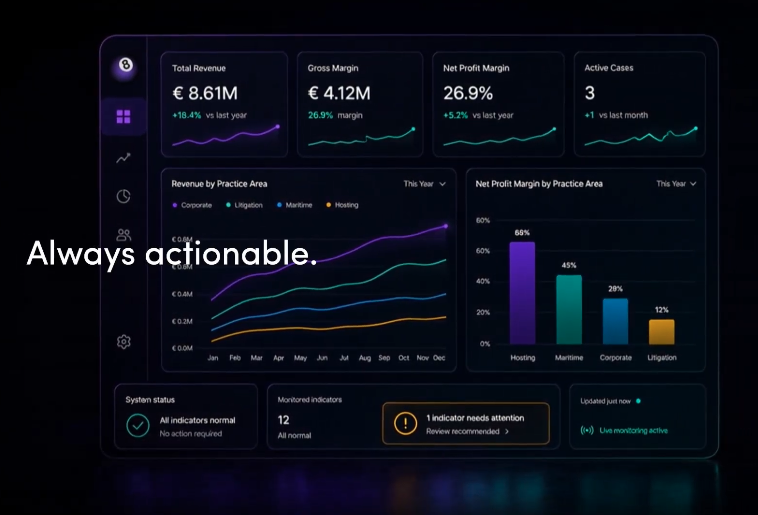
Actionable is a design choice made upstream, not a filter applied at the end. We design the reporting layer so the number the owner is looking at is one click away from the transaction that made it, and one conversation away from the decision it should inform. Every metric on screen has an owner. Every threshold has a meaning. Nothing is on the dashboard that doesn't earn its place by changing what someone does.
That's the standard. It doesn't require prettier charts. It requires cleaner foundations and a design brief written for the person making the call, not the one running the report.
If the numbers your team produces are correct and still don't change decisions, that's usually a design problem, and it's a half-hour conversation.
A live 30-minute conversation. Nothing to prepare, no figures required. You leave knowing your biggest finance gaps and what to fix first.
Book the CallKEEP READING
Manufacturing finance breaks in a specific way, and it doesn't break loudly.

Privately held hospitality breaks in the same order almost every time, from single-property owner-operators to multi-property groups.

What businesses lose when senior, industry-specific finance support isn't in place: money, time, opportunities, and quietly compounding risk.