
Why Manufacturers Can't See Their Own Margins
Manufacturing finance breaks in a specific way, and it doesn't break loudly.

EARLY WARNING
Most failures are catchable months earlier if someone is watching the right five numbers.
Almost every business failure I've reviewed had a warning phase. The pattern isn't crisis-out-of-nowhere. It's a series of small drifts that nobody flagged, each one explainable on its own, none of them added up until it was too late to act cheaply. If someone had been watching the right handful of numbers weekly, most of those failures were catchable. Nobody was.
In hospitality, the drift usually hides inside a strong-looking top line. Occupancy is fine. ADR is holding. RevPAR is up on last year. Underneath, receivables are stretching quietly with corporate accounts, food-cost percentage is creeping up half a point a month because a supplier changed a rebate structure and nobody caught it, seasonal payroll is running two per cent above budget because a bonus pool got approved verbally, and the CapEx overrun on the room refurb is being financed out of working capital that was already thin. Each one on its own is a rounding error. Together, they're the reason the bank balance in November feels a lot tighter than the P&L in October promised.
In manufacturing, the drift lives inside the cost base and the inventory. A raw material moves three per cent. A yield ratio slips on one line. WIP quietly builds because a delivery window slid. Fixed-price customer contracts that made sense at last year's input costs are now underwater on this year's, and nobody has re-modelled them. The margin looks like the margin used to look, right up until it doesn't.
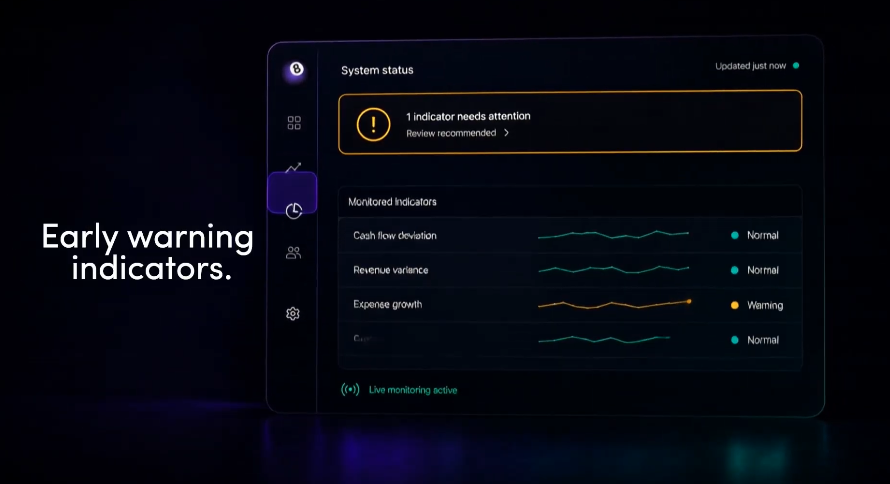
Early warning indicators are the mechanism 8PEX builds so the owner sees the drift while it's still cheap to fix. Not fifty metrics. A tight set of numbers that predict the P&L rather than report it, with thresholds set to the actual shape of the business, and a live monitoring layer that flags when one of them is starting to move outside its band. The point isn't to alarm anyone. The point is to compress the time between something starting to break and someone deciding to act on it.
The best CFOs I've worked with didn't spend their time on beautiful reports. They spent it watching a small handful of numbers weekly, and getting louder when one of them moved. We build that layer, we set the thresholds with you, and we watch the numbers with you.
If your business is performing on paper and you have a nagging sense that something is drifting underneath, that's the half-hour conversation to have.
A live 30-minute conversation. Nothing to prepare, no figures required. You leave knowing your biggest finance gaps and what to fix first.
Book the CallKEEP READING
Manufacturing finance breaks in a specific way, and it doesn't break loudly.

Privately held hospitality breaks in the same order almost every time, from single-property owner-operators to multi-property groups.

What businesses lose when senior, industry-specific finance support isn't in place: money, time, opportunities, and quietly compounding risk.